
"The Mathematics of the S in ESG: A New Framework for NGO Collaboration"
Billions of rands are currently flowing into ESG (Environmental, Social and Governance) funds and Corporate Social Investment (CSI) portfolios globally. Yet a glaring imbalance exists at the heart of the ESG industry.
The "E" (Environmental) has become a hard science. Carbon emissions, water usage and waste reduction are tracked, quantified and optimised using rigorous data models. But the "S" (Social) remains notoriously difficult to measure. When corporations invest in community development or non-profit partnerships, they are often forced to rely on fluffy storytelling, anecdotal success or simplistic input metrics (for example, "we donated R1 million to education").
Traditional philanthropy is often viewed as a sunk cost. But modern ESG capital demands measurable Social Yield (positive human and societal returns such as job creation or healthcare access), risk mitigation and peak capital efficiency. To achieve this we cannot rely on outdated siloed models of non-profit intervention. We must stop viewing community development purely as a charitable endeavour and start treating it as a complex mathematical equation.
By shifting from deterministic top-down planning to a decentralised collaborative "Mesh" model, we can align non-profit capital deployment with the established operations research and economic optimisation models used in high finance.
Here is the science behind how a decentralised Mesh can fundamentally rewrite the rules of ESG impact, applied through the lens of multi-sectoral Early Childhood Development (ECD) interventions.
1. The Multi-Dimensional Knapsack Problem: Maximising Social Yield Under Constraints
The Corporate Translation: Imagine an impact investor with a strictly capped budget and a mandate to deploy capital across 20 different ECD centres. There are dozens of potential interventions (infrastructure, teacher training, food security and literacy) each with a different cost and a different projected impact. The goal is not just to spend the budget but to assemble a portfolio of interventions that generates the absolute highest aggregate social ROI without violating internal compliance or budget constraints.
The Science (Combinatorial Optimisation): In mathematics this is known as the Multi-Dimensional Knapsack Problem. When deploying CSI capital across an ECD cluster we aren't just making a single choice; we are dealing with combinatorial optimisation.
Using Integer Linear Programming a collaborative consortium of NPOs does not just guess what a community needs based on emotion. Instead, the model seeks the exact mathematical combination of discrete interventions that yields the highest cumulative "Developmental Impact Score". It does this while strictly adhering to multidimensional constraints, specifically a rigid 30/20/18/16/16 percentage budget allocation across five core developmental pillars. This ensures that corporate capital is deployed not just where it is easiest but where the exact combination of resources unlocks the highest measurable yield for ESG reporting.
2. The Greedy Algorithm with a Heuristic Correction: Balancing NGO Specialisation with Corporate Alignment
The Corporate Translation: If you let highly specialised NPOs loose in a community they will naturally gravitate toward what they are best at. An infrastructure NGO will fix roofs and install sanitation; a food security NGO will create gardens. They will make the most obvious high-impact choice immediately in front of them. This is efficient on a micro level but on a macro level it creates stranded assets (in this example, ECDs that get a great roof but no books). To ensure an ESG portfolio is balanced and comprehensive a macro-level mechanism must step in to plug the gaps.
The Science (Algorithmic Logic): In Phase 2 of our Mesh model, where specialised non-profits autonomously select intervention sites based on their expertise, the system relies on what computer scientists call a "Greedy Algorithm".
A greedy algorithm makes the locally optimal choice at each stage with the hope of finding a global optimum. Specialised NPOs act independently to select sites where their specific interventions have the highest probability of success. However, computer scientists know that greedy algorithms occasionally miss the absolute global maximum because they don't look ahead.
This is where Phase 3 (The Shared Pool) comes in. The Shared Pool acts as a heuristic correction. It is a designed safety net that reviews the macro-landscape after the greedy algorithm has run its course and steps in to fix systemic blind spots. It reallocates shared corporate resources to ensure that high-potential ECDs achieve full integration, ensuring the corporate funder's macro ESG goals are met comprehensively across the entire portfolio.
3. Dynamic Programming and Diminishing Marginal Returns: Ensuring Peak Capital Efficiency
The Corporate Translation: In economics the law of diminishing returns dictates that the value of an investment eventually plateaus. If an ECD centre receives a new building, specialised teacher training and a food garden, those are massive upgrades. But does stacking a fourth or fifth intervention at that same ECD yield five times the impact? Or would the corporate capital spent on that fifth intervention at "ECD A" actually generate a higher social ROI if it was used as the very first intervention at a struggling "ECD B"?
The Science (Dynamic Optimisation): To guarantee peak capital efficiency for ESG investors, we must manage diminishing marginal returns through dynamic programming. Dynamic programming breaks a complex problem down into simpler sub-problems and solves them continuously over time.
In the Mesh model we do not blindly stack resources just to exhaust a budget. Dynamic programming principles are applied to continuously calculate the marginal utility of capital. The system evaluates whether the capital required for a 4th or 5th intervention at a highly saturated ECD would yield a higher net socio-economic impact if deployed elsewhere. The Shared Pool balances this equation in real-time, moving capital fluidly across the 20 ECDs. For the ESG manager this guarantees that every single rand is perpetually operating at its peak efficiency curve.
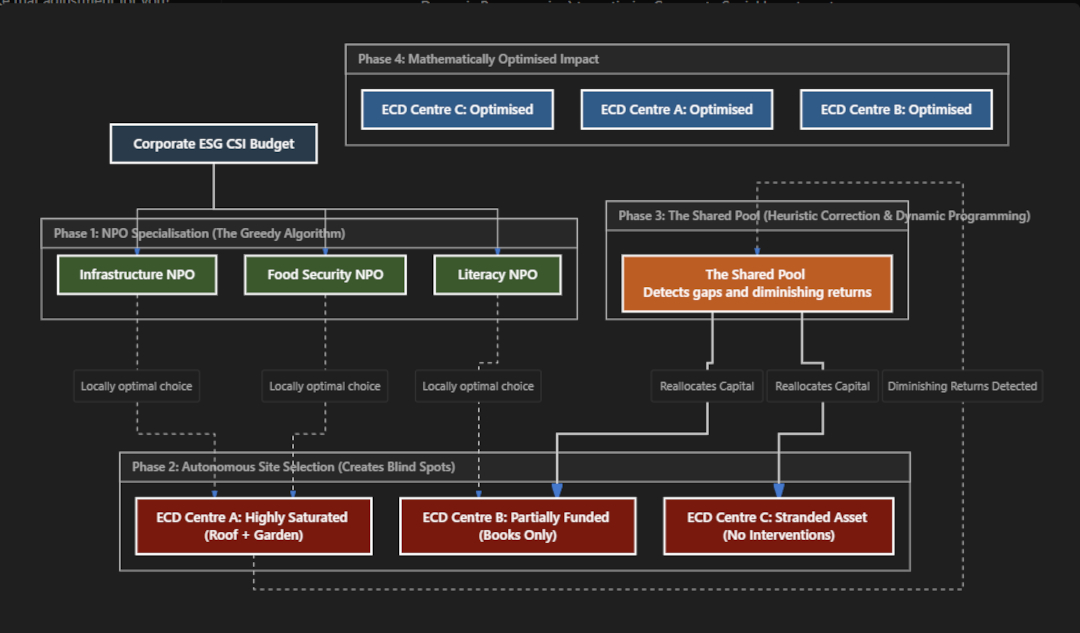
How to Read the Diagram:
- Phase 1 & 2 (The Greedy Algorithm): NPOs naturally act as "greedy algorithms". They deploy their specific skills where they see an immediate local need. This is great for ECD A, but it leaves ECD B under-supported and ECD C completely ignored (a "stranded asset").
- Phase 3 (Heuristic Correction & Dynamic Programming): The Shared Pool acts as the intelligence layer. It sees that adding a 3rd intervention to ECD A has diminishing returns, so it captures that capital and redirects it to the blind spots (ECD B and C).
- Phase 4: The final portfolio is perfectly balanced, ensuring maximum social ROI (an increasingly important ESG metric) across the entire corporate investment.
4. Factorial Design and Interaction Effects: Proving the ROI of Social Investment
The Corporate Translation: When compiling an annual sustainability report, ESG managers need empirical proof that their investments actually worked. Historically non-profits have measured their impact in isolation. The literacy NGO measures reading scores; the nutrition NGO measures BMI. But they rarely measure how the food makes the child better at reading. Corporate stakeholders don't just want to know that ingredients were purchased; they want mathematical proof that the recipe compounded in value.
The Science (Statistical Variance): An 8-Year Longitudinal Study tracking this Mesh model will not just measure the main effect of isolated interventions. Because the decentralised Mesh naturally creates variance, with different ECDs receiving different combinations of the five pillars, researchers can utilise a Factorial ANOVA (Analysis of Variance).
A Factorial Design allows statisticians to measure the interaction effect between variables. Does early literacy intervention (Variable A) combined with nutritional security (Variable B) yield a higher developmental score than the sum of A and B measured separately?
By leveraging the natural data variance created by the Mesh, this framework will provide empirical statistical proof of exactly how multi-sectoral development compounds. This is the holy grail for ESG reporting: moving beyond anecdotal success stories to provide mathematical proof of synergy. It proves to shareholders that when capital is deployed collaboratively 1 + 1 truly equals 3.
Conclusion: From Charity to Mathematically Optimised Impact
The challenges facing our communities are too complex, and corporate capital is too highly scrutinised to rely on outdated models of siloed intervention. The "S" in ESG can no longer afford to be the unquantifiable sibling of the "E".
By embracing the principles of operations research (Combinatorial Optimisation, Heuristic Corrections, Dynamic Programming and Factorial Statistics) we can strip the guesswork out of ESG / CSI and subsequent sustainability reporting.
The Mesh model is not just a new methodology for non-profits to work together. It is a rigorous mathematically defensible architecture for human development. It guarantees to impact investors that every intervention is targeted, every gap is covered and every rand is deployed exactly where it will yield the highest social return.
It is time to move from the art of charity to the science of impact.
Just a thought.
Frequently Asked Questions
Is Operations Research usually applied to social development?
About the Author
Chris Wild is the CEO of Food & Trees for Africa. A GIBS graduate, he drives organisational strategy through a lens of innovation, systems, and data. He pairs this visionary leadership with deep, hands-on field experience in rural South Africa.