"Biological Inflation: Why Food Security Without Nutrition Is a Mirage"
South Africa counts its harvests in tonnes. Our bodies count them in milligrams. Closing that gap requires a new agricultural and economic metric.
Every season, South Africa’s Crop Estimates Committee announces how many millions of tonnes of white maize, wheat and soybeans our farmers will bring in. When the silos fill and exports flow, the country declares itself food secure.
But food security without nutrition is a mirage.
Look past the national harvest figures to our public clinics and the problem is obvious. Roughly one in four South African children under five is stunted. That is a permanent physical and cognitive deficit caused by chronic undernutrition. The same national health survey found anaemia in around six in ten young children and three in ten women of reproductive age. At the same time, adult obesity, hypertension and Type 2 diabetes are rising fast within the very same communities (and often under the same roof).
South Africa is not short of calories. It is short of nutrients.
Public health researchers rightly point to the spread of cheap, ultra-processed food as a major driver of this crisis. Yet a quieter problem starts long before food reaches the supermarket shelf. Over the past fifty years, the raw fruits, vegetables and grains we grow have lost much of their nutritional value.
At Food & Trees for Africa (FTFA), we call this biological inflation. Its root cause on the farm is the tonnage trap.
Biological Inflation: Paying More Rand for Less Nutrition
Every month, Statistics South Africa tracks the consumer price index and the Pietermaritzburg Economic Justice & Dignity group publishes the cost of a household food basket. Both tell us, down to the cent, how many more rands a low-income family must spend on maize meal, potatoes, onions or spinach compared to last year.
Neither measures what is left inside the food.
Biological inflation is the steady drop in the nutrient value of every rand spent on food. Put simply, a bunch of spinach costs more at the till today while delivering less iron and magnesium to the body.
For decades, dietary guidelines and poverty lines have assumed that a tomato, a cob of maize or a leaf of spinach has a fixed nutritional value. The data says otherwise. Biochemist Donald Davis and his colleagues tracked United States Department of Agriculture food composition records across 43 garden vegetable crops between 1950 and 1999. They found consistent drops across six core nutrients. Median protein fell by 6%, calcium by 16%, iron by 15%, vitamin C by 15% and riboflavin (vitamin B2) by 38%. In the United Kingdom, Anne-Marie Mayer’s review of historical government records showed that copper (essential for human immunity and iron absorption) fell by around three quarters in everyday vegetables.
South Africa has never published an equivalent historical audit of its own Medical Research Council (SAMRC) food composition tables. We track food prices to the decimal point while flying blind on food quality.
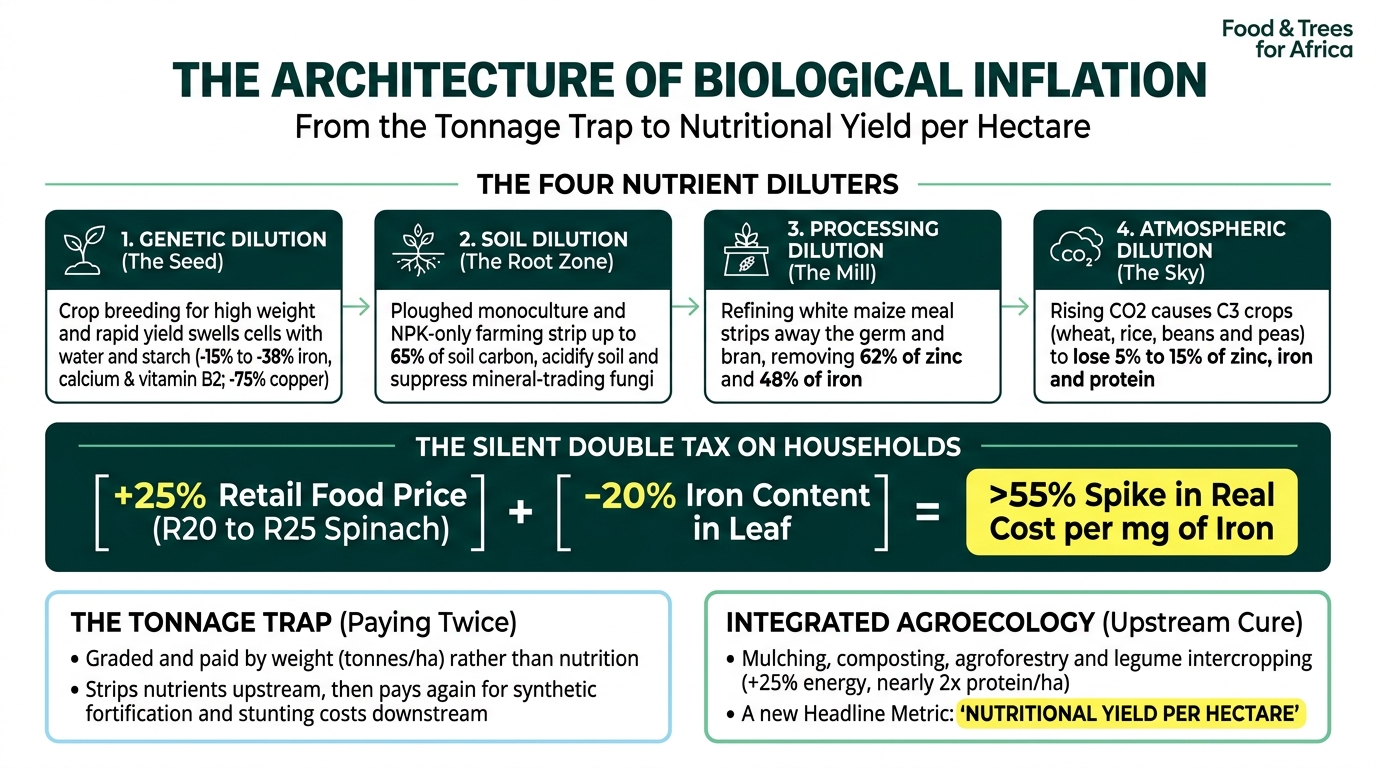
The maths is simple and unforgiving. Suppose a bunch of spinach rises in price from R20 to R25. That is a 25% increase at the till. If that same bunch of spinach contains 20% less iron than it used to, the real cost per milligram of iron has not risen by 25%. It has risen by more than 55%.
This is a silent double tax on the poor. Wealthier households buy varied diets, animal proteins and supplements. Low-income families rely on a narrow basket of affordable staples, so every milligram of mineral nutrition lost from those crops cuts directly into a child’s development. (Which is why at Food & Trees for Africa we focus so heavily on home, school and community vegetable and herb production, where one of our core metrics of project success is the increase in crop diversity.)
The Four Diluters
Biological inflation does not have a single cause. The research points to four distinct mechanisms that strip nutrition between the seed and the plate.
1. Genetic dilution. For over sixty years, commercial crop breeders have selected seed varieties almost entirely for yield, fast growth and uniform appearance. Davis linked most of the nutrient drop in those 43 vegetable crops to what he called the genetic dilution effect. When plants are bred to grow bigger and faster, their cells fill with water and carbohydrates faster than their roots can pull in minerals. Long-term wheat archives studied by Ming-Sheng Fan and colleagues show the same pattern. Grain zinc, iron, copper and magnesium fell sharply after high-yield semi-dwarf varieties arrived in the 1960s, even in test plots where soil mineral levels stayed exactly the same.
2. Soil dilution. Seed genetics are only the start. Even the best vegetable or grain variety cannot absorb minerals that the soil cannot supply. Plants do not make iron, zinc, calcium, magnesium or selenium out of thin air. They rely on a living soil network of organic carbon, bacteria and mycorrhizal fungi. These microbes and fungi release mild acids and enzymes that unlock minerals from soil particles and trade them to plant roots in exchange for sugars.
Long-term soil research in South Africa shows how badly we have damaged this underground exchange. Studies across the Highveld grain belt show that converting native grassland into continuously ploughed monoculture cropland has wiped out up to 65% of soil organic carbon and 55% of soil nitrogen. Markers for soil microbial life have dropped by 60%.
This soil loss hits both sides of South Africa’s farming divide. In smallholder areas, continuous cropping without compost or manure has exhausted the land. Soil surveys in the Eastern Cape by Mandiringana and colleagues found that 79% to 100% of smallholder fields were critically short of available phosphorus and over 83% were depleted of potassium.
On commercial farms, heavy reliance on synthetic NPK fertilisers (nitrogen, phosphorus and potassium) creates a different problem. Ammonium-based nitrogen fertilisers acidify the soil, which leaches away calcium and magnesium while releasing aluminium that stunts roots. Even when phosphorus builds up in heavily fertilised fields, crops absorb only 10% to 18% of what is applied because machinery compacts the carbon-poor soil and high chemical inputs suppress the fungi that carry phosphorus and zinc to the root. Furthermore, human bodies need roughly twenty mineral elements to stay healthy, not three. Across South Africa’s maize belt, sulphur deficiency has emerged because purified NPK blends lack sulphur. Plants need sulphur to build essential amino acids like methionine and cysteine, so sulphur-poor soils produce grain with poorer-quality protein.
A 2021 study in Nature by Dawd Gashu and colleagues across Southern and Eastern Africa proved why this matters for human health. The zinc, selenium and calcium content of cereal grains varied widely depending on the local soil where the crop was grown. Simply put, your soil is your supplement.
3. Processing dilution. In South Africa, our biggest and most fixable nutrient loss happens at the mill. Most households prefer bright, super-refined white maize meal over sifted or whole-grain meal. Industrial roller-milling and dehulling strip away the germ and bran before the meal leaves the factory. A 2025 milling study in Malawi led by Thokozani Ngoma showed that conventional dehulling removes 62% of the zinc and 48% of the iron from maize.
4. Atmospheric dilution. Rising carbon dioxide adds a fourth pressure. Field experiments published in Nature by Samuel Myers and colleagues showed that under elevated carbon dioxide levels, C3 food crops pack on extra starch while losing 5% to 15% of their zinc, iron and protein. While C4 crops like maize and sorghum are largely spared from this specific effect, almost all vegetables, leafy greens, herbs, beans, peas, wheat and rice are C3 plants. The very crops we rely on to diversify South African diets are losing nutrition as emissions rise.
The Architecture of Biological Inflation: From the Tonnage Trap to Nutritional Yield per Hectare
The Tonnage Trap and the Wheat Precedent
Why has our food system let all four diluters run unchecked? Because agricultural markets pay farmers for weight and appearance, not nutrition.
In the fresh produce market, cabbages, spinach, tomatoes, carrots and onions are sold by crate weight and shelf-life. A commercial grower whose synthetic nitrogen programme produces heavy, watery cabbages with diluted trace minerals earns more per hectare than a regenerative grower producing smaller, mineral-dense leaves and herbs.
The same rule governs our main staple grain. Under the Agricultural Product Standards Act, white maize (WM1, WM2 or WM3) is graded on physical defects, foreign matter, fungal damage and moisture. There is not a single nutritional measure in the table. A farmer who invests in soil health to grow maize rich in zinc, iron and amino acids gets the exact same price per tonne as a farmer delivering hollow starch.
Yet South Africa’s own regulations prove we can do things differently. When a farmer delivers bread wheat, the grading table includes minimum protein levels (from 12% for Grade B1 down to 9% for Grade B4). Wheat farmers get paid more for higher protein.
The baking industry brought in protein grading so bread would rise properly, not for public health. Even so, the principle holds. The tonnage trap is a policy choice, not a law of nature. Our markets already know how to test and pay for biochemistry when we decide it matters. And with new handheld near-infrared (NIR) spectrometers able to estimate the mineral and phytonutrient content of vegetables, herbs and grains in seconds, grading food by nutrient density is now practical at scale.
The High Cost of Paying Twice
Until we fix the tonnage trap, South Africa is stuck paying twice for a broken system.
First, our farming and milling practices strip micronutrients out of our soils, vegetables and grains upstream. Then, under mandatory fortification rules introduced in 2003, we require millers to add synthetic iron, zinc, vitamin A and B vitamins back into refined maize meal and wheat flour (with compliance studies often finding that retail samples miss these targets). Finally, the public purse carries the heavy downstream cost of child stunting, anaemia and diabetes through crowded hospitals, lost schooling and lower economic productivity.
In neighbouring Malawi and Zambia, the contradiction is even sharper. Both countries spend a large share of their agricultural budgets subsidising synthetic NPK fertiliser for maize monocultures, and then use separate health and donor budgets to hand out micronutrient supplements to the very same rural families.
Food fortification is an important safety net and has saved lives. But adding synthetic powder at the factory is a patch, not a cure. It cannot replace nutrient-dense vegetables and living soils.
Integrated Agroecology: Fortifying Food at the Source
Fixing biological inflation means intervening where food is grown. It also requires scientific honesty. Agroecology cannot magic zinc, iron or selenium out of soils that never had them in the parent rock. What it can do is rebuild the living soil network that unlocks existing minerals for plant roots, paired with targeted mineral additions where soils are naturally short.
The problem is not mineral nutrition itself. The problem is NPK-only monoculture: the belief that three chemical salts can replace a living ecosystem and supply the twenty minerals human bodies need.
South African field data shows how well soils respond when we bring biology back. In a sugarcane trial at Mount Edgecombe in KwaZulu-Natal running for nearly sixty years, keeping crop residues on the field as mulch instead of burning them rebuilt soil organic carbon, restored potassium levels and improved soil structure. Long-term rotation trials in KwaZulu-Natal and the Highveld show that adding legumes and living roots unlocks trapped soil phosphorus and lifts microbial life above even unploughed grassland levels.
In eastern Zambia, nine-season trials led by Blessing Mhlanga compared monocropped maize with agroecological plots that intercropped maize and legumes. The intercropped fields produced 25% more total energy and nearly doubled the protein yield per hectare (from 263 to 517 kilograms of protein a year).
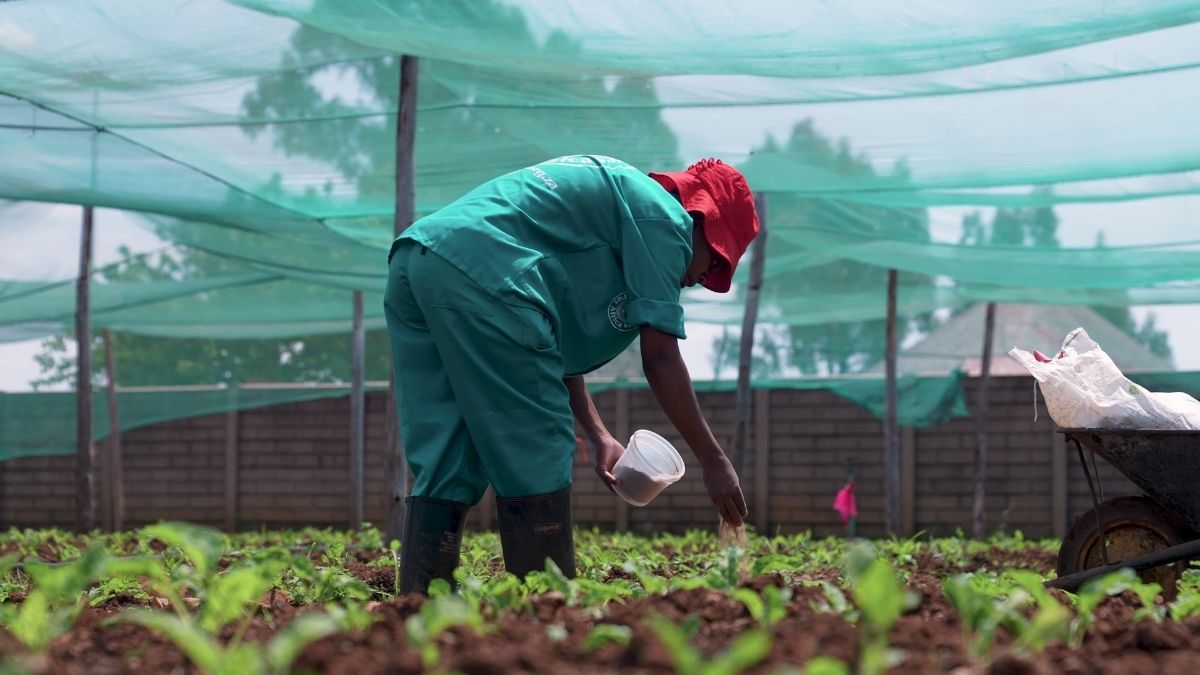
At Food & Trees for Africa, we put this science to work every day through school, home and community vegetable and herb gardens. Instead of planting single-crop rows in dead dirt, our growers dig deep organic trench beds, mulch heavily to hold water and intercrop leafy greens, root vegetables, legumes, fruit trees and herbs. Companion herbs do more than keep pests away without chemicals; they pack concentrated trace minerals, iron and antioxidants into daily meals. By tracking crop diversity alongside soil health, agroecological gardens tackle all four diluters at once.
A Blueprint for Measuring Nutritional Yield
Over a decade ago, researchers including Emily Cassidy and Ruth DeFries proposed replacing tonnes per hectare with Nutritional Yield per Hectare. This metric counts how many people’s daily needs for protein, iron, zinc and vitamins a hectare of farmland can actually meet. No government has yet put it into official use. South Africa should lead the way.
Here are three practical steps to get there:
1. Track biochemistry alongside weight. Whenever the Crop Estimates Committee reports expected harvest tonnes, it should publish a parallel Nutritional Yield estimate showing how many people’s annual protein, iron and zinc needs that crop will meet. At the same time, Statistics South Africa, the SAMRC and food-basket researchers should run South Africa’s first historical nutrient dilution audit and pilot a Nutrient-Adjusted Food Price Index (tracking rand per milligram of iron or zinc in a basic grocery basket).
2. Use public procurement and finance to reward nutrient density. Following the example of protein grading in wheat, big buyers should start rewarding nutritional quality. The National School Nutrition Programme feeds over nine million learners every school day. Together with Land Bank blended finance and corporate ESG funds, it has huge market power. Tying farm finance and school supply contracts to soil carbon, pH balance and crop mineral density will make regenerative farming the most sensible business choice for emerging and commercial growers alike.
3. Benchmark the nutritional value of agroecological produce. Over the past three decades, FTFA has helped establish thousands of permaculture gardens, community farms and food orchards across South Africa. As the next step in our data-driven work, we are inviting universities, laboratories and corporate ESG partners to join us in open-access research comparing the mineral density of regeneratively grown FTFA garden produce against standard supermarket produce.
South Africa has spent a century perfecting how to count its harvest in tonnes. Now we need to count it in milligrams. Until we value the life in our soil as much as the weight in our silos, food security without nutrition security will remain a mirage.
Just a thought.
About the Author
Chris Wild is the CEO of Food & Trees for Africa. A GIBS graduate, he drives organisational strategy through a lens of innovation, systems, and data. He pairs this visionary leadership with deep, hands-on field experience in rural South Africa.