What is Urban Forestry and Why Does It Matter?
Key Takeaways
- Urban forestry delivers measurable cooling, pollution control and public health benefits to city residents.
- Historical segregation creates lasting disparities in green infrastructure access across South African cities.
- Municipalities must prioritise long-term maintenance funding to ensure high tree survival rates.
- Planting indigenous trees reduces allergenicity risks and conserves critical groundwater resources.
What defines the urban forestry framework?
Urban forestry encompasses the deliberate planning and management of tree populations across municipal environments. It intersects heavily with green infrastructure, which integrates engineered ecological systems to provide specific environmental services like flood attenuation and pollutant filtration. Global planners use metrics like the 3-30-300 rule to set universal baseline targets. This framework dictates that residents must see three trees from their property, live in a neighbourhood with thirty percent canopy cover and reside within 300 metres of a public park (Browning M, Locke D, Konijnendijk C, et al., 2023).
How do canopy systems influence city environments?
Trees intercept rainfall and reduce the urban heat island (UHI) effect through direct shading and evapotranspiration. Global assessments show that mature canopy networks cool local street temperatures by up to 4°C. A comprehensive neighbourhood study in Tacoma recorded a 2.57°C variation across distinct districts. The data demonstrated that uncanopied areas exceed dangerous heat thresholds five times more frequently than fully shaded zones.
Key ecological and economic services
- Pollution control: The i-Tree Eco pilot in Torbay quantified local ecosystem services by proving the urban forest removes 50 tonnes of airborne pollutants annually. Planners must select species carefully because certain trees emit biogenic volatile organic compounds (BVOCs) that create harmful ozone concentrations (Livesley S, McPherson E, Calfapietra C., 2016).
- Health outcomes: Urban greening delivers documented mental health improvements. Prolonged exposure lowers self-reported stress and state anxiety while improving working memory and attention spans across diverse demographics.
What drives green infrastructure inequality in South Africa?
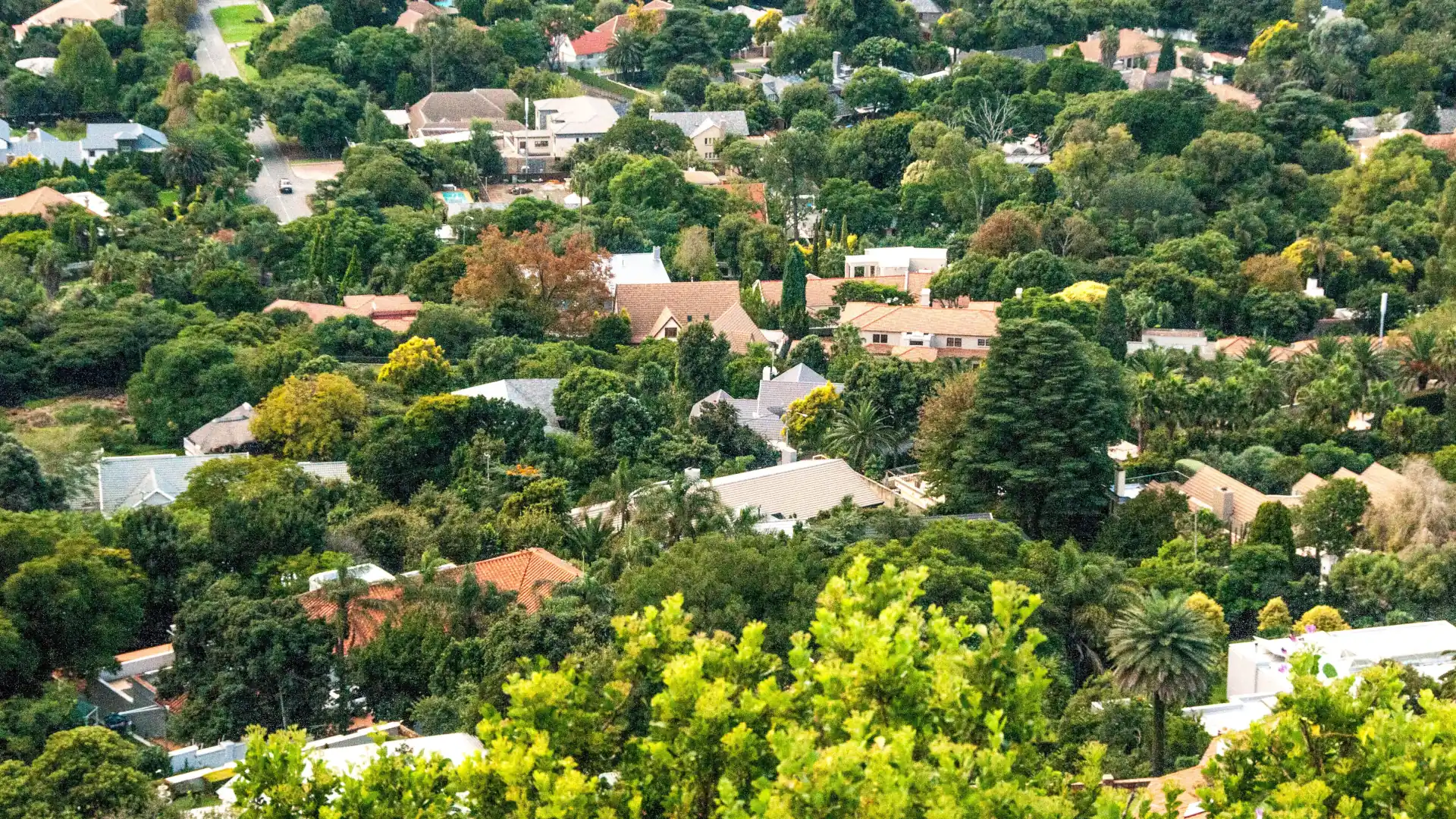
Historical segregation created lasting structural disparities across South African cities. High-income areas retain abundant vegetation while low-income zones completely lack basic street trees. This "green apartheid" restricts vulnerable populations from accessing critical cooling and recreational benefits (Venter Z, Shackleton C, Staden FV, et al., 2020). Municipalities now utilise the Spatial Planning and Land Use Management Act (SPLUMA) to embed climate adaptation directly into statutory development frameworks.
Old colonial planting regimes heavily favour exotic species like Jacaranda mimosifolia and Platanus acerifolia. These trees dominate established suburbs but cause severe allergenicity issues and consume excessive water. Ecologists strongly recommend planting indigenous trees like Combretum erythrophyllum, Vachellia and Senegalia species to reduce ecosystem disservices. Furthermore, South Africa spends billions annually clearing invasive Acacia mearnsii (black wattle) infestations that aggressively choke riparian zones and deplete groundwater reserves.
How do municipalities govern urban ecosystems?
Cities worldwide join peer learning networks like the C40 Urban Nature Accelerator to share operational strategies. Singapore successfully scaled biophilic urbanism in a high-density environment while Melbourne pioneered coordinated metropolitan canopy targets through its Living Melbourne strategy. For a practical look at how practitioners apply these principles at ground level, FTFA's resources on Urban Forestry provide detailed operational guidance.
South African municipalities face severe operational challenges regarding species selection, tree planting logistics and ongoing maintenance budgets. The Greening Soweto project achieved its initial planting targets but recorded a dismal 43% survival rate due to inadequate aftercare. Authorities must continuously track pathogens like the Polyphagous Shot Hole Borer (PSHB) to prevent widespread canopy collapse. Joburg City Parks and Zoo (JCPZ) coordinates disease monitoring while managing an estimated 10 million trees across the greater metropolitan area.
| Municipality | Flagship Programme | Core Focus and Outcomes |
|---|---|---|
Cape Town | Urban Forest Policy | Anchors trees in climate adaptation and aligns with the local biodiversity network. |
Johannesburg | JCPZ Greening Initiatives | Manages millions of trees and distributes fruit trees to historically marginalised areas. |
Durban | Transformative Riverine Management | Uses an R8 billion business case to employ community co-operatives for stream cleaning. |
Tshwane | 10 Million Tree Planting Programme | Partners with national government to plant 2,000 mango trees for job creation. |
Nelson Mandela Bay | Baakens Valley Community Partnership | Restores a major green belt spanning five distinct ecological biomes. |
To see how municipal budgets influence riverine management sustainability, explore FTFA's resources on Water Stewardship.
Written By
Research Team
Comprising experts from diverse departments, the Food & Trees for Africa (FTFA) research team drives informed strategies to advance environmental sustainability, climate resilience and food security.
Found this resource useful?
Help us continue building an open-source knowledge economy for environmental sustainability. Your support funds our ongoing research.