What is the PSHB Beetle and Can We Stop It?
Key Takeaways
- The polyphagous shot hole borer attacks hundreds of tree species and spreads rapidly through the movement of infested wood.
- Female beetles cultivate a lethal fungus deep inside the tree that blocks the vascular system and starves the host.
- South Africa faces potential economic damages exceeding USD 164 billion over a decade as cities lose massive canopy coverage.
- Commercial wood chipping reduces beetle emergence by 97 percent and remains the most effective scalable intervention.
The polyphagous shot hole borer is an invasive ambrosia beetle that cultivates a lethal fungus inside host trees and threatens millions of urban and agricultural trees worldwide.
What is the polyphagous shot hole borer?
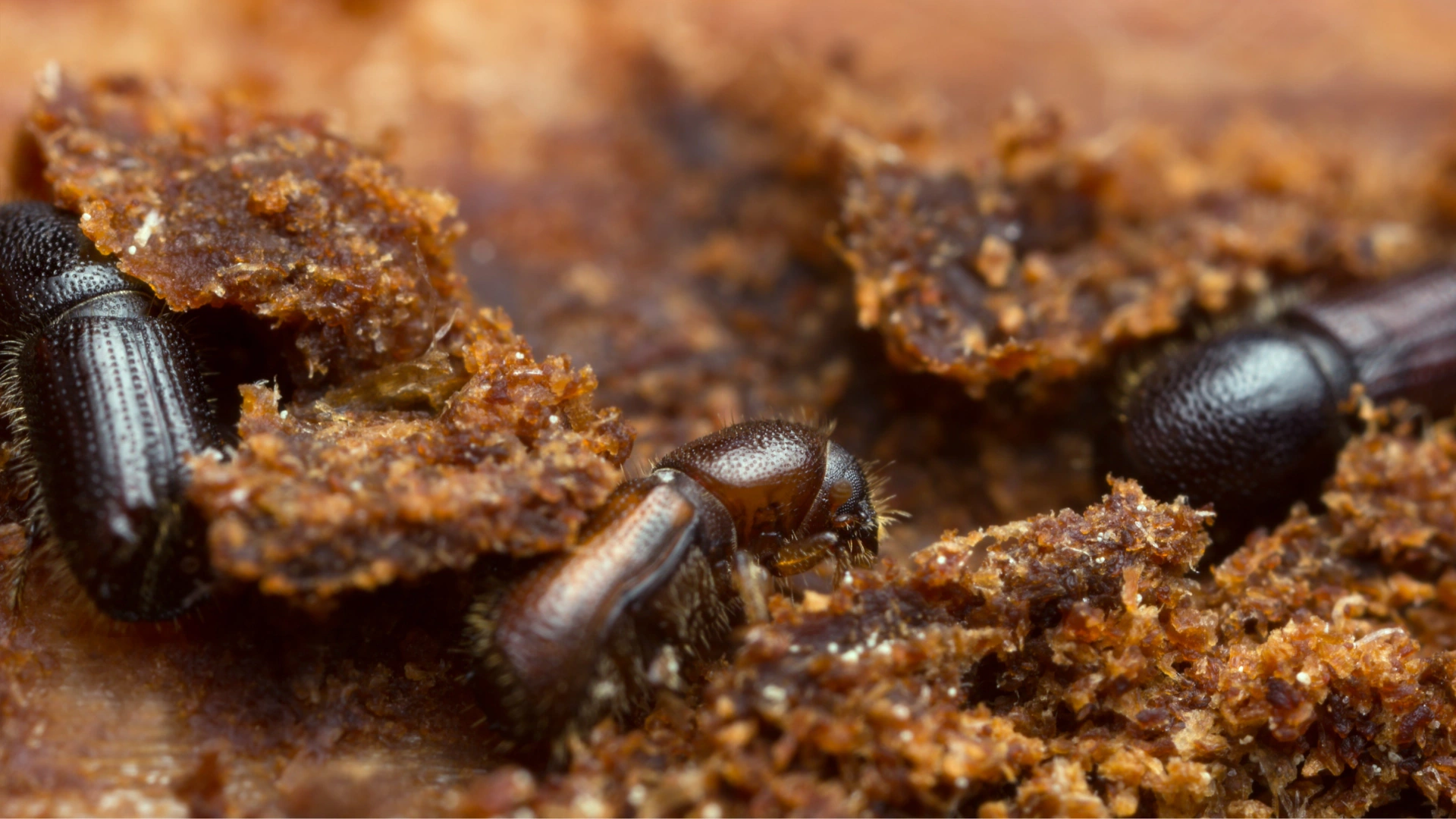
Originating in Southeast Asia, the polyphagous shot hole borer (PSHB) or Euwallacea fornicatus measures just 2 mm. It functions as a highly destructive invader alongside its symbiotic fungus Fusarium euwallaceae (now Neocosmospora euwallaceae).
Female beetles bore into trees and release the fungus into the xylem vessels. They cultivate this fungus as food inside their galleries. The fungus causes Fusarium dieback. This disease blocks the vascular system and starves the host tree.
How does the beetle spread across landscapes?
Unlike most bark beetles that target a single genus, PSHB attacks an exceptionally broad range of vegetation. Researchers discovered that 13.8 percent of 583 surveyed tree species serve as reproductive hosts. The beetle moves short distances naturally but spreads rapidly through human transport of firewood, mulch and untreated timber.
In South Africa, the invasion began in 2017 in Pietermaritzburg within KwaZulu-Natal and currently spans all provinces except Limpopo. A related variant called the Kuroshio shot hole borer (KSHB) caused similar devastation in California.
Affected tree categories
Scientists group targeted plants into distinct operational classifications based on their vulnerability.
| Host Category | Operational Definition |
|---|---|
Non-hosts | Plants showing no signs of attack |
Fusarium-colonised hosts | Trees where the fungus transmits but beetles cannot reproduce |
Competent hosts | Trees where beetles establish natal galleries and reproduce |
Kill-competent hosts | Trees documented to succumb to the fungal infection |
South Africa currently records 162 affected species. This inventory includes 78 indigenous trees, 84 competent hosts and 78 Fusarium-colonised hosts.
What economic and ecological damage occurs?
The most severe impacts occur in urban environments with concentrated canopies. In Johannesburg, 38 percent of the canopy consists of exotic species like Jacaranda mimosifolia, English oak, maples, sweetgum, sycamore, willow and the highly susceptible London plane (Platanus acerifolia). The Johannesburg City Parks and Zoo (JCPZ) warns the city faces catastrophic losses among its 10 million trees. The Johannesburg Urban Forest Alliance (JUFA) estimates losses will reach 30 percent.
Cape Town detected PSHB in Somerset West in 2019 and anticipates losing 1 million of its 4 million trees over a decade. By 2022, 10,000 trees succumbed in the Helderberg area. Other affected areas include Bitou, George, Knysna and Stellenbosch in the Western Cape.
The economic threat spans agricultural sectors including avocado, macadamias, wine grapes, stone fruit and pecans. Models project unmitigated damage to South Africa ranging from ZAR 49 billion to ZAR 275 billion (USD 2.7-164 billion) over a decade (de Wit et al., 2022). Economic losses will impact 3.5 and 15.5 percent of total tree populations.
Natural forests also face severe risks. In the Western Cape Afrotemperate forests, invasions increase by 7.5 percent to 10 percent annually near urban borders (Townsend et al., 2024).
Can municipalities stop the invasion?
Eradication proves exceptionally difficult. Western Australia spent A$45 million over three years in Perth. Cost models predict ongoing management will cost A$55-110 million, while total tree replacement would cost A$105-195 million. In Israel, growers bulldozed entire orchards in the Hefer Valley to halt the spread.
Municipalities rely on continuous monitoring and evaluation to track pathogen progression. CABI, SANBI, NEMBA, DALRRD, FABI, Stellenbosch University and UC Riverside coordinate global tracking frameworks.
| Outbreak Year | California Invasion Milestone |
|---|---|
2003 | First detection in Whittier Narrows, Los Angeles |
2003 to 2010 | Sporadic detection on ornamental trees |
2010 | Large die-off of box elder street trees in Long Beach |
2012 | Detection in South Gate backyard avocados and local botanical gardens |
2012 to 2016 | Mortality of California maple species exceeds 20 percent |
2023 | Presence confirmed across seven southern California counties |
Chemical and mechanical interventions
Treatment success varies significantly depending on the application method.
| Intervention Method | Efficacy and Outcome |
|---|---|
Emamectin benzoate injection | Significantly reduces colonisation and persists for 45 months |
Bifenthrin and metconazole cocktail | Provides temporary control for moderate infestations |
Propiconazole | Reduces colonisation when combined with systemic injections |
Zeta-cypermethrin | Acts as a contact chemical control for agricultural groves |
Mechanical sanitation | Chipping reduces beetle emergence by over 97 percent |
Surface insecticide sprays | Ineffective because the fungus lives inside the wood |
Commercial biocontrol (Eco-Bb® and Bio-Insek) | Lab efficacy translates poorly to field environments |
Eucalyptus oil | Ineffective because the active ingredient cannot reach the gallery |
Commercial chipping remains the most scalable intervention (Chen et al., 2020). Authentic ecological restoration demands removing infested timber entirely.
The Tijuana River Valley in San Diego experienced a complete boom-and-bust cycle over 5 years. Heavily damaged willow forests recovered through resprouts and seedlings, although invasive weeds like Arundo donax exploited the resulting canopy gaps. By year four, reinfestation rates dropped to 1-3 percent. While riparian systems recover naturally, urban streetscapes require active tree planting. Planting a wider variety of indigenous trees like Celtis africana provides the strongest structural defence against future outbreaks. For a practical look at how municipalities execute replacement strategies, FTFA's resources on Urban Forestry provide detailed operational guidance.
To understand how cities budget for invasive species clearing, explore FTFA's resources on Environmental Governance.
Written By
Research Team
Comprising experts from diverse departments, the Food & Trees for Africa (FTFA) research team drives informed strategies to advance environmental sustainability, climate resilience and food security.
Found this resource useful?
Help us continue building an open-source knowledge economy for environmental sustainability. Your support funds our ongoing research.