
Agroecology vs. Permaculture: What is the Difference?

Key Takeaways
- Agroecology is a tri-modal framework combining science, farming practices and social movements focused on food sovereignty.
- Permaculture is a design system applying ecological principles to whole-landscape planning including buildings, energy and water.
- Both systems overlap in techniques such as polyculture, soil building and reduced tillage.
- Scientific evidence supports both systems for soil health, though permaculture yields are less documented than agroecological ones.
- South African organisations often integrate both paradigms to build resilient household and community food systems.
Agroecology is a scientific, practice-based social movement focused on food system transformation, while permaculture is a design system applying ecological principles to integrate human habitats and production. Both frameworks share an empirical core of functional diversification and ecological care but differ in their political scope and design methodology.
What are the defining characteristics of agroecology and permaculture?
Agroecology manifests as a tri-modal paradigm. Wezel et al. (2020) consolidated the literature into 13 principles, including recycling, input reduction, synergy and social values. It applies ecological theory to design and manage food systems while maintaining explicit political commitments to equity and food sovereignty. This multi-modal character distinguishes it from purely technical approaches. It insists that how food is produced cannot be separated from who produces it and for whom.
Permaculture is a design system that applies ecological principles recursively. It operates through three core ethics: Earth Care, People Care and Fair Share. It functions as a framework for ecosystem mimicry and complex systems thinking optimisation. Practitioners treat design as the primary activity, observing site patterns and climate before placing elements to maximise energy efficiency. Unlike agroecology, permaculture extends its logic beyond the farm to buildings, energy systems and social structures.
How do the conceptual origins of these systems differ?
The conceptual foundations of these systems emerged in parallel during the 1970s. Agroecology consolidated as a science through the work of researchers like Miguel Altieri and Stephen Gliessman. They applied ecological theory to agroecosystems, drawing heavily on Indigenous and peasant farming knowledge across Latin America. It later transitioned into a formal policy framework elevated by the Committee on World Food Security in 2019.
The historical lineage of ecological farming
Permaculture originated in Tasmania through the work of Bill Mollison and David Holmgren. They codified twelve design principles that serve as an operational backbone for human settlement design. While agroecology began in academia and social struggles, permaculture emerged as a practical design response to fossil-fuel dependence. It democratised ecological design literacy through the 72-hour Permaculture Design Certificate (PDC), which has trained tens of thousands of designers globally.
What is the difference in operational scale and scope?
Agroecology focuses primarily on transforming the food system at farm and landscape scales. It addresses structural problems, such as corporate seed monopolies and land tenure, to improve food security. Cuba provides the most dramatic national-scale test of these principles. Following the 1991 Soviet collapse, the country transitioned to low-input, biodiverse production, becoming roughly 90% self-sufficient in fruit and vegetables.
Permaculture has a broader design scope but often scales down to the homestead and community level. It emphasises whole-system integration. A permaculture site plan coordinates where food is produced with how water enters, is stored and exits. Distinctive techniques include Keyline design for water management and the creation of multi-layered food forests. These systems mimic natural forest structures to produce fruit, nuts and perennial vegetables with minimal maintenance.
How does scientific evidence support these systems?
The empirical case for these traditions has grown significantly. Krebs and Bach (2018) found robust scientific evidence for all twelve permaculture principles drawn from the fields of ecology and systems science. Furthermore, Williamson et al. (2024) measured permaculture-managed allotments at three times higher microbial biomass and four times more carbon than conventional comparators.
Regarding productivity, Reiff et al. (2025) found that permaculture yields are comparable to organic and conventional agriculture. The study used the Land Equivalent Ratio (LER) to demonstrate that mutually supportive species contribute directly to system stability. However, Ferguson and Lovell (2013) note that permaculture's contributions to perennial polyculture and water management often exceed what is currently documented in the scientific literature.
Photosynthesis in these diverse systems functions like a solar-powered kitchen: plants use sunlight to convert carbon from the air into essential sugars, which they then share with soil life to keep the ecosystem running.
Why does South Africa integrate both systems for resilience?
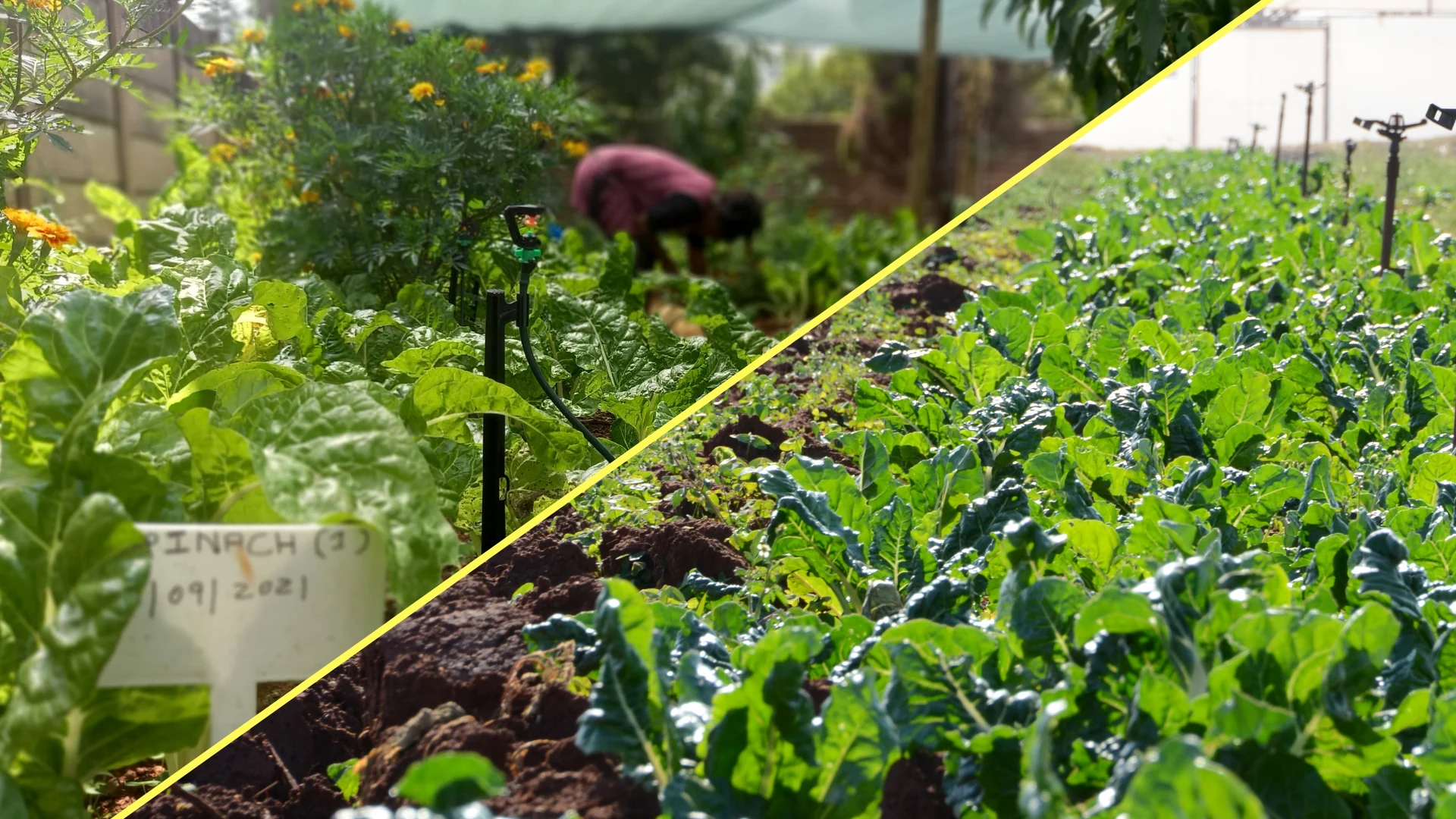
South African organisations integrate both paradigms to address extreme inequality and urban food insecurity. Organisations like SEED and Soil for Life apply design logic to transform schoolyards and sandy township soils into highly productive spaces. This blended approach builds climate resilience by restoring soil ecosystem function and reducing dependence on expensive chemical inputs.
For a practical look at how these principles are applied at ground level, FTFA's resources on School Gardens provide detailed operational guidance.
The South African case demonstrates that agroecology and permaculture are not foreign concepts. They align seamlessly with traditional homestead designs that have long integrated animal waste as fuel and fertiliser. By reclaiming this knowledge, communities can build autonomous food systems that actively regenerate the natural capital upon which production depends. To see how these diverse planting methods influence local production, explore FTFA’s resources on Food Security.
Written By
Research Team
Comprising experts from diverse departments, the Food & Trees for Africa (FTFA) research team drives informed strategies to advance environmental sustainability, climate resilience and food security.
Found this resource useful?
Help us continue building an open-source knowledge economy for environmental sustainability. Your support funds our ongoing research.