
Easy Vegetables to Grow in South Africa
Key Takeaways
- Bush beans, radishes and rocket yield harvests within 21 to 60 days.
- Intercropping principles maximise spatial efficiency and reduce pest pressure.
- Zucchini plants act as living mulch to suppress competitive weed growth.
- Fennel actively inhibits tomato growth and requires isolated companion planting.
- Healthy soil microbes suppress pathogens and improve plant nutrient uptake.
Why do beginner crops build soil biology?
Planting fast-growing pioneer vegetables does more than provide immediate food security. These crops act as biological pumps. Their root exudates feed microbial populations that aggregate soil particles. Radishes germinate in three to five days and fracture compacted earth. Bush beans fix atmospheric nitrogen. Swiss chard provides continuous leaf canopy cover which reduces surface evaporation. The Department of Agriculture (2026) reports that optimal cultivation of leafy greens like Swiss chard requires 20 to 25 mm of water per week to maintain this biological activity.
Think of the soil microbiome like a household sourdough starter. You must provide consistent moisture and organic food to keep the living culture active and producing. If you let it dry out completely the organisms go dormant or die and the system fails to convert raw materials into usable forms for the plant roots. Proper cultivation creates a self-sustaining cycle where increased soil organic matter retains more moisture and supports robust plant immunity.
What do you need before sowing seeds?
Site selection dictates your biological yield. Choose a location receiving six to eight hours of direct sunlight daily. Clear the site of existing weeds to remove root competition. Loosen the earth to a depth of 300 mm using a digging fork. Never turn the soil completely over because this destroys established fungal networks. Incorporate compost into the top 150 mm to feed the microbial layer. Test your drainage by filling a 300 mm hole with water. If it takes longer than one hour to drain you must build a raised bed to prevent root rot. Gather your seeds, a measuring tape, a hand trowel and a fine-rose watering can. As of 2026 check current municipal water bylaws regarding hosepipe restrictions before committing to a large planting area.
How do you plant your first vegetable cycle?
Begin by establishing a precise planting grid to maximise light interception and airflow. You will execute a direct seeding method for these pioneer crops because it eliminates transplant shock and preserves the taproot structure. It is also useful to utilise companion planting and intercropping techniques.
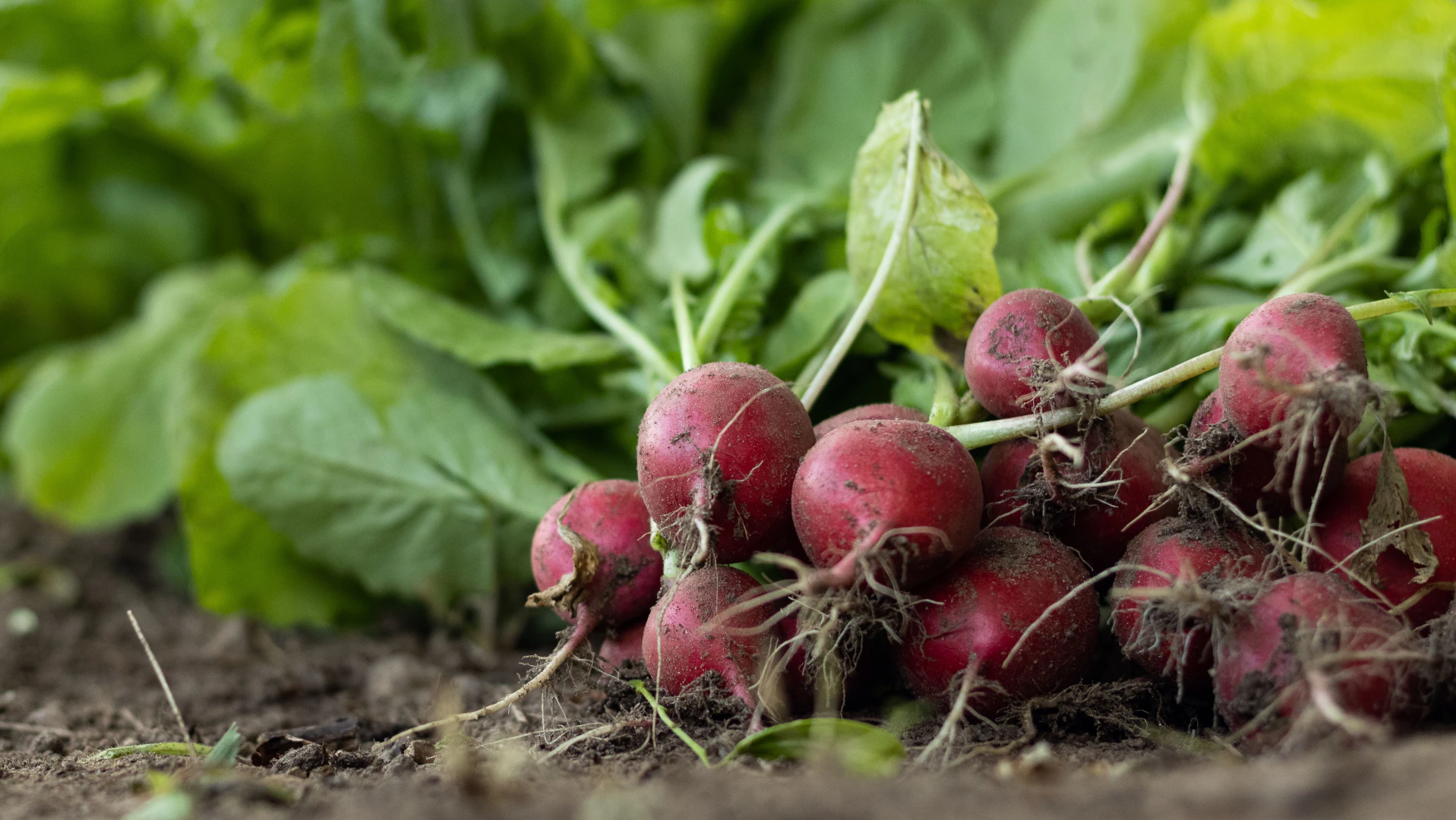
Start with radishes as your fast-maturing indicator crop. Draw a shallow furrow 10 mm deep using a hand trowel. Space the seeds thinly along the trench. Cover them lightly with fine soil and press down gently to ensure seed-to-soil contact. Radishes sprout in under a week and you must thin the seedlings to 50 mm apart once they produce their first true leaves. This prevents woody roots and overcrowding.
Move to your Swiss chard. This crop requires higher nitrogen availability. Space your rows 450 mm apart. Plant the seeds 20 mm deep and space them 150 mm apart within the row. Swiss chard seed clusters often produce multiple seedlings per hole. You must snip the weaker stems at soil level with scissors rather than pulling them out. Pulling disrupts the root systems of the surviving plants. For a practical look at how these principles are applied at ground level FTFA's resources on Soil Health provide detailed operational guidance.
Plant your bush beans in the warmest section of your prepared bed. Push the large seeds 25 mm into the earth and space them 100 mm apart. Bush beans grow densely and support each other physically against wind. Water the entire bed immediately using a fine-rose watering can to prevent seed displacement. You must supply 15 to 20 mm of water weekly during the germination phase.
Monitor the soil moisture daily. Push your index finger into the earth up to the first knuckle. If the soil feels dry at that depth you must irrigate. Remove competing weeds by pinching them at the base and pulling gently. Apply a 50 mm layer of organic mulch around the Swiss chard once the plants reach 100 mm in height to ensure moisture retention and regulate root temperature. Harvest radishes after 21 days by pulling the entire plant. Harvest Swiss chard after 70 days by cutting the outer leaves 50 mm above the base to encourage continuous regrowth.
How do you adjust for different soil types?
The physical properties of your site dictate the effort required. You must adjust your approach based on the earth.
Sandy Soil: Focus on incorporating heavy compost to retain the 20 to 25 mm of weekly water required for vegetable planting in porous ground.
Clay Soil: Use a digging fork to fracture the subsoil to 300 mm and plant seeds on raised ridges to prevent waterlogging.
Container Gardens: Select a potting mix with high perlite content and ensure pots are at least 300 mm deep for proper root extension.
Winter Rainfall Regions: Delay planting heat-loving beans until November and focus entirely on cold-tolerant radishes and leafy greens throughout the wet season.
Quick Reference Guide
Prerequisites Checklist:
Primary Tools & Materials:
- Organic compost
- Assorted vegetable seeds
- Two-metre wooden stakes
- Watering can or fine mist hose nozzle
- Measuring tape or spacing guide
- Shade cloth (for intense summer heat)
- Pickaxe (for breaking up heavy clay soil)
- Straw mulch (for sandy soil moisture control)
Step-by-Step Summary:
- Select a site receiving eight hours of direct sunlight.
- Spread organic compost over the growing area.
- Install vertical supports for tomatoes and chou moellier.
- Plant tall crops along the central axis.
- Sow zucchini seeds at the bed edges.
- Interplant lettuce and rocket in the understory.
- Fill remaining gaps with radish seeds.
- Plant fennel in a separate companion border.
- Water the bed immediately with a fine mist.
- Harvest mature crops continuously to promote yield.
Written By
Research Team
Comprising experts from diverse departments, the Food & Trees for Africa (FTFA) research team drives informed strategies to advance environmental sustainability, climate resilience and food security.
Found this resource useful?
Help us continue building an open-source knowledge economy for environmental sustainability. Your support funds our ongoing research.